
Rediff.com's Prasanna D Zore and Uttam Ghosh/Rediff.com travelled 650 km in Chhattisgarh's Sukma and Bijapur districts to report on the situation that exists 11 days after the Burkapal ambush, where 25 CRPF troops were killed by the Maoists.

The highly anticipated matchup between Hillary Clinton and Donald Trump finally happened, and it didn't disappoint. Here are all the highlights from the first presidential debate.
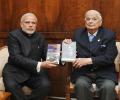
Tarun Vijay, MP, salutes the General whom he adored as a great friend.

'While economic ties are making incremental progress, it is in the security and strategic domains that the India-Japan synergy is more compelling,' says Dr Rajaram Panda.
'Under Narendra Modi's leadership, we will be able to regain our rightful place in the community of nations,' veteran diplomat Hardeep Singh Puri, who joined the BJP on January 2, tells Rediff.com's Sheela Bhatt.

Defence Minister Manohar Parrikar expects to see progress in India-US defence relations at the speed of a year per month.
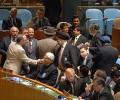
A white powder was found wrapped in a paper close to the seat of the Leader of the Opposition Ram Govind Choudhry.

'These ISIS terrorists want to smash Western civilisation, smash India. For the time being though, their main target would be the US and Europe.'

'It is in the interest of both sides that the visit of the US President is seen as being successful. Both sides have invested considerable political capital in it. This rapid exchange of visits and the decisions taken have to be justified, beyond the symbolism, which is no doubt important in itself. This opportunity to impart a fresh momentum to ties should not be missed,' says former foreign secretary Kanwal Sibal.

'Mohammad Akhlaq's death isn't only about a Muslim being killed out of sheer communal bigotry, but also the denial of the Constitutional guarantees of "due process" under Article 21 and the freedom of choice,' says Shehzad Poonawalla, who has moved the National Commission for Minorities over the murder.
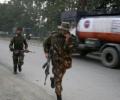
'No amount of economic measures or prosperity in Kashmir will make any dent in the situation there. The average Kashmiri understands the Pakistani game and is unlikely to prefer Pakistan over India. But the Pakistanis have made clever use of religious symbols and slogans to force religious-minded Kashmiris to support them. India has failed to counter this posturing by the separatists,' says Colonel Anil A Athale (retd).

Isn't National Intelligence Grid and UIDAI engineered by vested interests, asks Gopal Krishna.

Why is Xi Jinping visiting Saudi Arabia, Egypt and China this week? Former RA&W officer Jayadeva Ranade explains the significance of China's outreach to the Middle East.

A K Bhattacharya digs into the yet-to-be-public report on ways to curb black money and finds out that Modi's next moves could include action on dabba trading, hawala, and education.

'India is no longer the India of the '70s and the '80s.' 'It's a large country with the fastest growing economy.' 'In working with India, you just can't go and humiliate the nation publicly.' USIBC President Mukesh Aghi tells Aziz Haniffa/Rediff.com about how he advises American companies to do business with India, what he thinks of Modi's government and the way forward for the India-US relationship.

'It is a great misfortune that the Nehruvian Stalinists of India have colluded with the grand project of demeaning and destroying Sanskrit. Today, the number of Sanskritists in India is low, and falling,' says Rajeev Srinivasan.

Rediff.com's Prasanna D Zore reports from Bhopal and Manikhedi Kot, Etkhedi Kot and Kejra Dev, about the October 30-31 escape and encounter in which 8 prisoners were killed, a case that has many questions and few answers.

'India was in no position to wage another war in 1965, having suffered a morale-shattering defeat in 1962. The three services were in the middle of a modernisation and expansion phase and therefore not fully trained or battle-ready.'

Concluding the three-part series, Paranjoy Guha Thakurta says that the black money law is likely to fail because of the ineptness of India's investigative and enforcement agencies.

Moving ahead with their new mantra -- Chalein Saath Saath: Forward Together We Go -- Prime Minister Narendra Modi and United States President Barack Obama on Tuesday vowed to deepen cooperation in every sector for the benefit of global stability and people's livelihoods over the next ten years.

With Beijing having had a profound rethink on India's admission as a full member of the Shanghai Cooperation Organisation, the tectonic plates of the geopolitics of a massive swathe of the planet stretching from the Asia-Pacific to West Asia are dramatically shifting. That grating noise in the Central Asian steppes will be heard far and wide -- as far as North America, says Ambassador M K Bhadrakumar.
